


Predict Brain Exposure Early in Drug Discovery
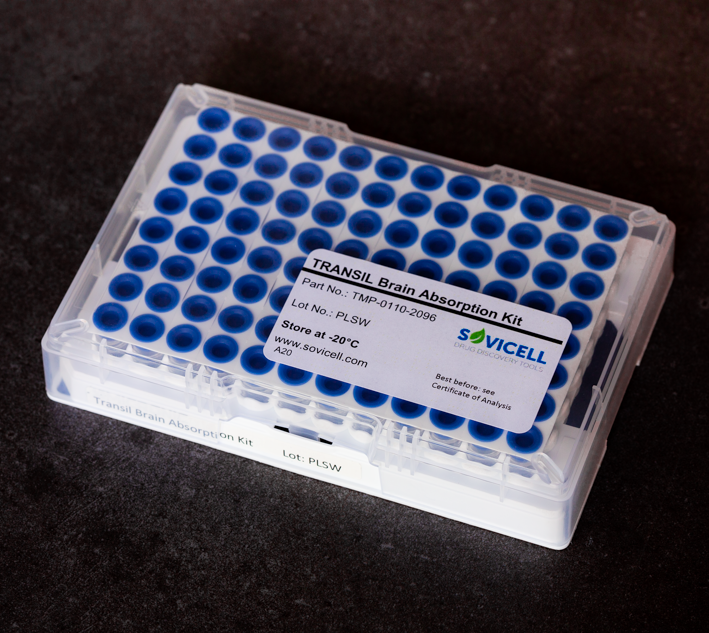
The TRANSIL Brain Absorption Kit enables rapid in-vitro prediction of brain tissue binding, brain free fraction (fu,brain), and key CNS exposure parameters such as Kp,uu,brain and logBB from membrane affinity measurements — delivering results within minutes instead of the hours required for traditional dialysis-based assays.
Key benefits:
- Predict brain free fraction (fu,brain)
- Estimate Kp,uu,brain
- Estimate brain-to-plasma distribution (logBB)
- Rank compounds by brain availability and CNS efficacy
- Matrix-free, automation-ready assay
- Results within minutes instead of hours
- Robust internal quality control
- Automation compatible
Predicting Brain Exposure
Predicting brain exposure is challenging because pharmacological activity depends on the free drug concentration in the brain, not the total drug concentration. Many drug candidates—particularly lipophilic compounds—bind strongly to brain lipids and proteins, which reduces the unbound fraction available to interact with receptors. Consequently, accurate assessment of brain exposure requires understanding both brain penetration and brain tissue binding.
Why Brain Tissue Binding Matters
Brain tissue binding is a key determinant of the pharmacologically active drug concentration in the CNS. Many compounds partition strongly into the lipid-rich membranes that dominate brain tissue. While this increases the total drug concentration measured in the brain, it simultaneously reduces the unbound fraction in brain (fu,brain) that can interact with receptors. As a result, compounds with similar brain penetration can exhibit very different pharmacological effects depending on their brain tissue binding.
Assessing brain tissue binding is not only important for CNS drug development but also for non-CNS drug programs. Compounds intended for peripheral targets may still penetrate the brain and reach pharmacologically relevant free concentrations in the CNS, potentially causing adverse neurological effects such as sedation, dizziness, or cognitive impairment. Early evaluation of brain exposure therefore helps identify molecules with unwanted CNS activity and supports the design of drugs with improved safety profiles.
The TRANSIL Brain Absorption Kit
The TRANSIL Brain Absorption assay estimates brain tissue binding by measuring the affinity of drug candidates to brain lipid membranes. Increasing amounts of immobilized brain membrane surface are incubated with a fixed compound concentration, and the remaining free compound in solution is quantified after equilibrium is reached. From the change in free concentration across the membrane gradient, membrane affinity is calculated and used to estimate key CNS exposure parameters such as fu,brain, Kp,uu,brain and logBB.
How the Assay Works
The assay measures membrane affinity using a simple equilibrium partitioning experiment. A fixed amount of compound is incubated with increasing amounts of membrane-coated beads. After equilibrium is reached, the beads are separated and the remaining compound concentration in the supernatant is quantified. From this change in free concentration, membrane affinity and the corresponding CNS exposure parameters are calculated.
The assay determines brain tissue binding through the following equilibrium partitioning workflow:
- Compound is added to wells containing increasing amounts of membrane- coated beads
- Compound partitions between membrane and aqueous phase
- Supernatant concentration is quantified
- Membrane affinity is calculated
- fu,brain, Kp,uu,brain and logBB are derived from the measured brain membrane affinity

Cross-Species Applicability
The TRANSIL Brain Absorption assay is well suited for cross-species use because brain tissue binding is largely conserved across common preclinical species and humans. This reflects the broadly similar lipid-rich composition of mammalian brain tissue. Experimental studies have shown strong correlations in fu,brain across species, indicating that differences in passive brain tissue binding are typically small compared with species differences in BBB transport or disease-related effects.
Features and Benefits
-
Measures affinity to brain membranes
Quantifies how strongly compounds partition into brain lipid membranes, a major driver of brain tissue binding. This provides mechanistic insight into brain exposure instead of relying only on empirical CNS ranking.
-
Predicts brain tissue binding and brain free fraction
The assay output can be used to estimate fu,brain, helping to distinguish total brain exposure from pharmacologically relevant free exposure. This supports better prediction of CNS efficacy and receptor-relevant brain concentrations.
-
Estimates Kp,uu,brain
Supports prediction of the unbound brain-to-plasma concentration ratio, a key parameter for assessing pharmacologically relevant CNS exposure. Thus, it helps distinguish true free brain exposure from total brain uptake.
-
Enables estimation of logBB
The supplied analysis model combines membrane affinity with additional compound properties to predict the brain-to-plasma distribution coefficient (logBB). This helps rank compounds by expected brain penetration early in discovery.
-
Matrix-free, cell-free assay format
The assay uses immobilized brain membranes on silica beads rather than tissue homogenates, slices, or live-cell systems. This reduces assay complexity, avoids tissue handling, and minimizes matrix-related analytical issues.
-
Compatible with standard analytical readouts
Supernatants can be quantified by LC-MS/MS, HPLC-UV, scintillation counting, and related methods. Fits easily into existing analytical workflows without requiring specialized instrumentation.
-
Rapid 12-minute incubation
Provides fast results without the long equilibration times required for dialysis- based binding assays.
-
Useful for both CNS and non-CNS projects
The method helps identify compounds with high expected free brain exposure, whether that is desired or should be avoided. Supports both CNS drug discovery and early de-risking of CNS side effects in peripheral programs.
Validation Against Equilibrium Dialysis
The TRANSIL Brain Absorption Kit was validated against equilibrium dialysis with brain homogenate, the established reference method for measuring fu,brain. In a study covering 65 marketed and proprietary CNS-active compounds across a broad physicochemical range, TRANSIL delivered fu,brain estimates that closely matched dialysis results while offering a much faster, matrix-free workflow (Figure 1).
A second validation study included 29 structurally diverse CNS-active compounds spanning a wide range of physicochemical properties and brain tissue binding affinities. As shown in Figure 2, the fu,brain values obtained with the TRANSIL Brain Absorption Kit closely match those determined by equilibrium dialysis with brain homogenate across the entire compound set. The strong correlation between both methods demonstrates that membrane affinity measurements provide a reliable and substantially faster alternative to dialysis-based assays for determining brain tissue binding.
This close correlation indicates that membrane partitioning is the dominant driver of brain tissue binding for most compounds and that the TRANSIL format captures this behavior well in a rapid, practical assay. As a result, the kit provides a robust basis for early ranking of compounds by fu,brain and for identifying candidates with favorable or unfavorable brain exposure profiles before moving into more resource- intensive studies.
Together, these results demonstrate that the TRANSIL Brain Absorption Kit provides fu,brain estimates comparable to equilibrium dialysis while offering a significantly faster and simpler workflow.


-
How does the TRANSIL Brain Absorption Kit work?
The TRANSIL Brain Absorption Kit measures the affinity of a test item to immobilized porcine brain membranes with natural membrane fluidity. This membrane affinity is a partitioning coefficient of drug between membrane and buffer. It is defined as the concentration of drug in membrane (cl) over the concentration of drug in buffer (cb):

The membrane affinity is calculated from the assay data using the mass balance equation:

which is rearranged such that the membrane affinity can be determined from the slope of plotting the ratio of total amount of drug (nt) over remaining concentration in supernatant (cb) against the lipid membrane volume present in each well:

-
How do the results from the TRANSIL Brain Absorption Kit compare literature data?
-
What are the main quality control measures applied in TRANSIL assays?
-
How long does it take to run the assay?
-
How many compounds can be analyzed with one plate?
-
Are TRANSIL assay kits supplied in low-binding plates?