


Correct Metabolic Rate Bias in Microsomal and Hepatocyte Stability Assays
Rapid measurement of membrane binding to calculate fu(mic) and fu(hepatocyte) and correct intrinsic clearance estimates.
Membrane Binding Distorts Metabolic Stability Data
In microsomal and hepatocyte stability assays it is often assumed that the total drug concentration is available for metabolism. In reality, many compounds bind extensively to intracellular membranes such as the endoplasmic reticulum, mitochondria, or plasma membrane.
This reduces the unbound drug concentration available to metabolic enzymes and leads to systematic underestimation of intrinsic clearance.
For example, a compound with fu = 0.01 will produce an apparent clearance that is 100-fold lower than the true intrinsic clearance. This bias can lead to incorrect compound ranking, misleading IVIVE predictions, and inaccurate assessment of drug–drug interaction risk.
The TRANSIL Metabolic Bias Assay
The TRANSIL Metabolic Bias Assay measures the membrane affinity of a compound using immobilized biological membranes. From this affinity, the unbound fraction in microsomal or hepatocyte incubations can be calculated for any experimental condition. Because membrane affinity is an intrinsic physicochemical property of the compound, the measurement can be used to correct metabolic stability assays across different protein concentrations or cell densities.
Unlike dialysis-based binding assays, the TRANSIL approach determines membrane affinity within minutes and avoids compound degradation or solubility artifacts that often occur during long equilibrium incubations.
Key advantages:
- Rapid 12-minute incubation
- No enzymatic degradation during measurement
- Direct compatibility with LC-MS workflows
- Applicable to both microsomes and hepatocytes
Why Correcting Metabolic Bias Matters
Accurate estimation of intrinsic clearance is essential for predicting human pharmacokinetics and selecting the best drug candidates during lead optimization. In microsomal or hepatocyte stability assays, however, many compounds bind extensively to intracellular membranes, which reduces the unbound drug concentration available for metabolism. If this effect is not corrected, the measured metabolic rate reflects the total concentration rather than the biologically relevant free concentration, leading to systematic underestimation of intrinsic clearance. Correcting for membrane binding therefore improves compound ranking, strengthens in vitro–in vivo extrapolation (IVIVE), and provides more reliable estimates of drug–drug interaction risk by ensuring that metabolic turnover and inhibition are interpreted based on the true unbound drug concentration.
The TRANSIL Approach
The TRANSIL Metabolic Bias Kit quantifies membrane binding using Sovicell’s established TRANSIL membrane affinity technology. In this assay, biological membranes are immobilized on silica beads and incubated with the test compound at several defined membrane surface densities. The compound partitions between the aqueous phase and the immobilized membrane phase according to its intrinsic membrane affinity. Because membrane affinity is a physicochemical property of the compound, the measurement can be used to calculate unbound fractions across a wide range of experimental conditions.
After a short incubation, the beads are separated by centrifugation and the remaining compound concentration in the supernatant is quantified using standard analytical methods such as LC-MS/MS or HPLC-UV. From the change in supernatant concentration across increasing membrane levels, the membrane affinity of the compound is determined and used to calculate the unbound fraction in microsomal or hepatocyte incubations (fu) under the conditions used in metabolic stability assays. This enables straightforward correction of intrinsic clearance estimates for membrane binding bias.
How the Assay Works
The assay determines microsomal and hepatocyte membrane binding through the following equilibrium partitioning workflow:
- Compound is added to wells containing increasing amounts of membrane- coated beads
- Compound partitions between membrane and aqueous phase
- Supernatant concentration is quantified
- Membrane affinity is calculated
- fu(mic) or fu(hepatocyte) is derived for the desired assay conditions

Cross-Species Applicability
The membrane affinity measured with the TRANSIL Metabolic Bias Kit reflects the intrinsic partitioning of a compound into biological lipid membranes. Because the basic architecture and lipid composition of cellular membranes are highly conserved across mammalian species, membrane affinity is largely independent of the species from which microsomes or hepatocytes are derived. Studies of liver microsomes have shown that the relative proportions of the major phospholipids—such as phosphatidylcholine, phosphatidylethanolamine, phosphatidylserine, and sphingomyelin—as well as the cholesterol-to-phospholipid ratio are very similar between species including human and rat.
As a result, the membrane affinity determined in the TRANSIL assay can be used to estimate unbound fractions in microsomal or hepatocyte incubations from different preclinical species. By combining the measured membrane affinity with species- specific parameters such as microsomal protein concentration or hepatocyte density, the supplied analysis tools allow prediction of fu(mic) and fu(hepatocyte) under the experimental conditions used in metabolic stability studies.
Features and Benefits
-
Direct measurement of membrane affinity
Determines the intrinsic partitioning of compounds into biological membranes, enabling calculation of the unbound fraction in microsomal and hepatocyte incubations.
-
Correction of intrinsic clearance estimates
Allows accurate correction of metabolic stability data by accounting for membrane binding, improving the reliability of intrinsic clearance calculations.
-
Applicable to both microsomes and hepatocytes
One measurement can be used to calculate fu(mic) and fu(hepatocyte) under different experimental conditions, supporting a wide range of metabolic stability assays.
-
Rapid 12-minute incubation
Provides fast results without the long equilibration times required for dialysis- based binding assays.
-
No risk of metabolic degradation during measurement
Because the assay does not require long incubations with active enzymes, compound degradation does not confound binding measurements.
-
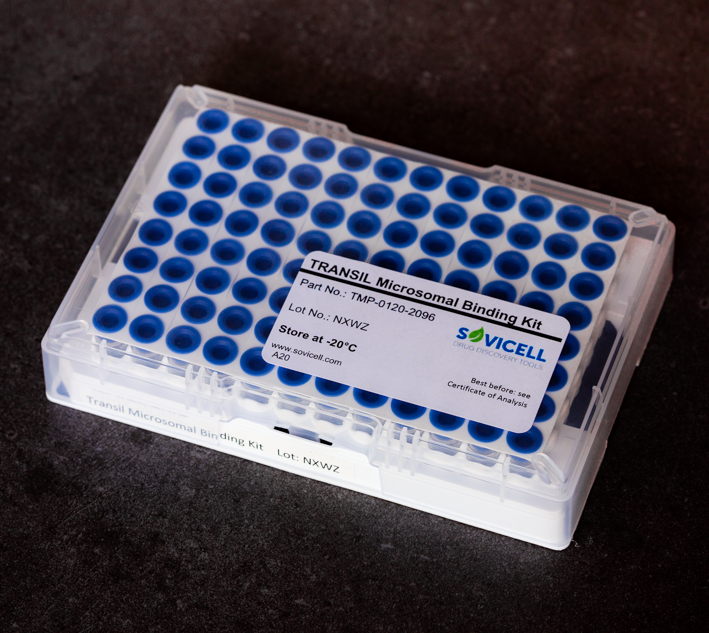
Ready-to-use 96-well plate format
Enables straightforward integration into standard ADME workflows and allows up to 12 compounds per plate.
-
Compatible with standard analytical methods
Supernatants can be quantified using LC-MS/MS, HPLC-UV, scintillation counting, or other detection technologies.
-
Automation-friendly workflow
The plate format and short protocol are compatible with liquid handling systems used in high-throughput screening environments.
-
Quantitative data analysis with built-in QC metrics
The supplied analysis spreadsheet calculates membrane affinity, unbound fractions, and quality parameters to ensure reliable results.
-
Supports improved IVIVE and DDI prediction
More accurate unbound drug estimates strengthen pharmacokinetic predictions and improve the assessment of drug–drug interaction risk.
-
How comparable are the results of the TRANSIL Microsomal Binding kit to dialysis?
Choosing a diverse compound set of 22 drugs we observed a strong correlation (r2=0.97) between the results from the ready-to-use TRANSIL kits and dialysis with microsomal homogenates. This indicates that the methods are highly comparable and validates the assumption that microsomal binding is attributable to membrane binding alone.

-
How comparable are the results of the TRANSIL Microsomal Binding kit to literature data and QSAR predictions?
-
Why is it important to measure microsomal and hepatocyte binding?
-
Why is microsomal binding important in prediction of clearance from in vitro microsomal clearance incubations?
-
Can I use the results from the TRANSIL Microsomal Binding kit also for estimating hepatocyte binding?
Yes, the TRANSIL Microsomal Binding Kit can also be used to estimate hepatocyte binding because it determines the affinity of test items to liver microsomal membranes and they differ only marginally in their composition to hepatocyte membranes.

-
What does the TRANSIL Microsomal Binding kit measure?
The TRANSIL Microsomal Binding Kit measures the affinity of a test item to immobilized microsomal membranes with natural membrane fluidity. This membrane affinity is a partitioning coefficient of drug between membrane and buffer. It is defined as the concentration of drug in membrane (cl) over the concentration of drug in buffer (cb):

The membrane affinity is calculated from the assay data using the mass balance equation:

which is rearranged such that the membrane affinity can be determined from the slope of plotting the ratio of total amount of drug (nt) over remaining concentration in supernatant (cb) against the lipid membrane volume present in each well:

-
What positive and negative control is used in the assay?
-
What are the main quality control measures applied in TRANSIL assays?
-
How long does it take to run the assay?
-
How many compounds can be analyzed with one plate?
-
Are TRANSIL assay kits supplied in low-binding plates?