


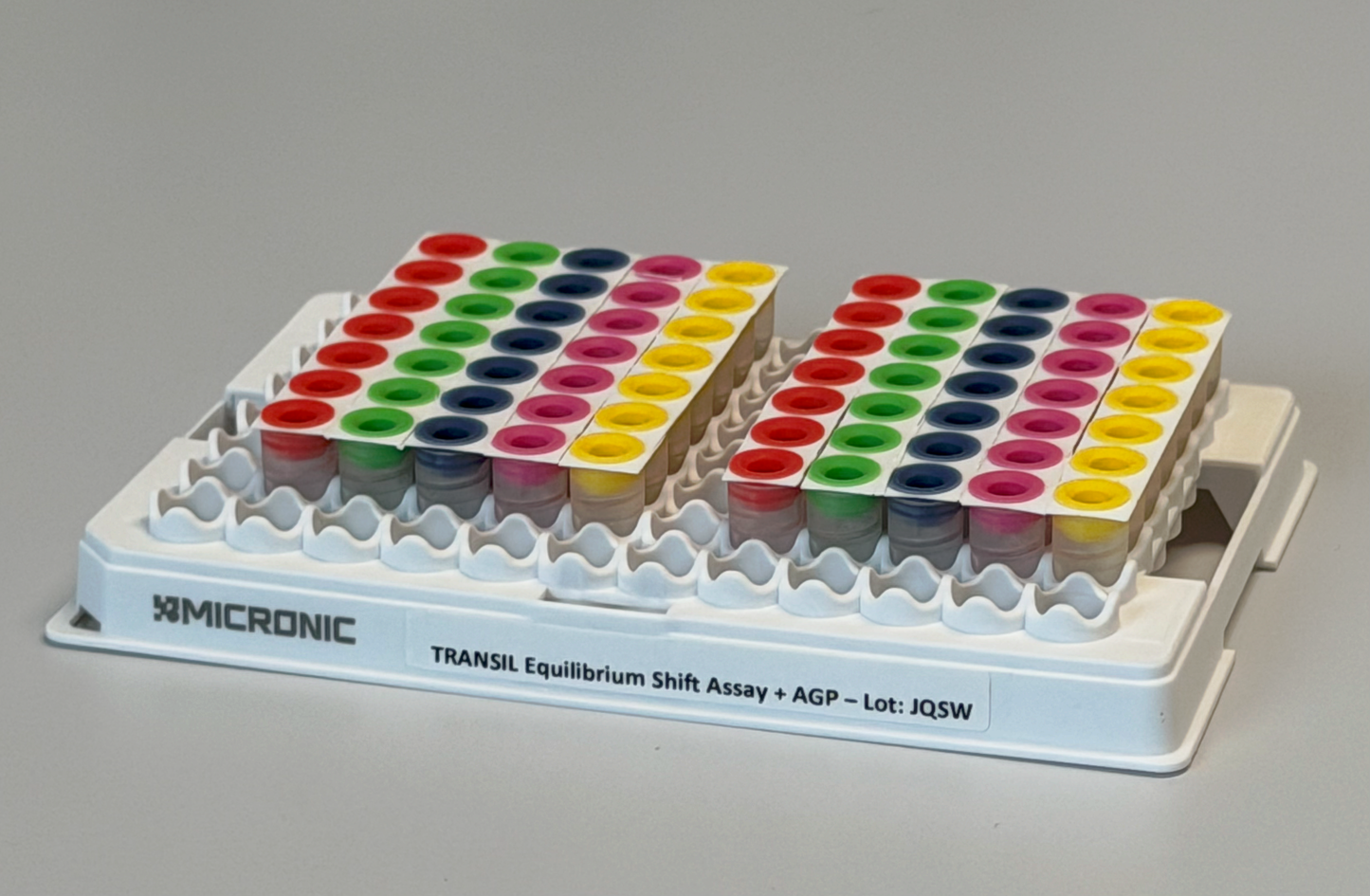
Next-Generation Plasma Protein Binding Analysis
A next-generation equilibrium shift assay that delivers accurate plasma protein binding data across modern drug modalities using albumin-based equilibrium shifts and advanced nonlinear modeling.
Key benefits
- Accurate plasma protein binding across challenging binding regimes
The equilibrium shift design enables reliable determination of plasma protein binding even for compounds that exhibit very strong binding or complex binding behavior.
- Advanced nonlinear binding analysis
A mechanistic differential equation model accurately describes binding equilibria even under strongly non-linear conditions or when saturation kinetics occur.
- Works across modern drug modalities
Validated for semaglutide, the assay is suitable for peptides, macrocycles, lipidated peptides, PROTACs, bRo5 compounds, and other complex modalities that often challenge conventional plasma protein binding assays.
- Robust under strong plasma dilution
The mechanistic analysis remains reliable even when plasma dilution induces non-linear binding behavior that would distort classical analyses.
- Short incubation time
Equilibrium is typically reached within 30 minutes, enabling efficient screening and analysis of compounds that may be unstable during long dialysis experiments.
- Mechanistic binding parameters for PK modelling
The model-based analysis provides quantitative binding parameters that support pharmacokinetic modeling and rational optimization of albumin- and/or AGP-binding drugs.
- Second-generation assay technology
Improved assay design and analysis pipeline with patent-pending innovations.
When to Use the TRANSIL Equilibrium Shift Assay
The ESA assay is particularly useful when plasma protein binding must be determined under conditions where binding becomes strongly non-linear due to high affinity interactions or strong plasma dilution.
Use the ESA kit if your compound
- binds very strongly to plasma proteins (fu well below 1%)
- exhibits non-linear binding behavior across plasma dilution series
- shows saturation kinetics or site-specific plasma protein binding
- is an albumin-binding peptide or long-acting peptide therapeutic
- shows low recovery in dialysis or ultrafiltration assays
- exhibits non-specific binding to assay materials such as membranes or plastics
- is unstable during long dialysis incubations
- requires mechanistic binding parameters for pharmacokinetic modeling
Modalities Best Addressed by ESA kit
The ESA assay was designed to characterize plasma protein binding for modern drug modalities whose binding behavior is often difficult to analyze using classical plasma protein binding assays.
- Classical small molecules
- Highly lipophilic small molecules
- “Sticky” compounds with strong non-specific binding
- Large heterobifunctional molecules
- PROTACs
- Peptides
- Cyclic peptides
- Stapled peptides
- Hormone analog peptides
- Lipidated peptides (fatty-acid conjugated peptides)
- Macrocycles
- Macrocyclic small-molecule drugs
- Small protein fragments
- Antibody fragments (e.g., Fab, scFv)
Limitations of Conventional Plasma Protein Binding Assays
Many classical plasma protein binding assays, such as equilibrium dialysis or ultrafiltration, rely on analytical models that assume simple linear binding equilibria between drugs and plasma proteins. Under these assumptions, the fraction of drug bound to plasma proteins is expected to scale proportionally with protein concentration across plasma dilution series. However, this assumption is frequently violated for compounds that bind strongly to plasma proteins or interact with a limited number of high-affinity binding sites.
When binding affinity is high, dilution of plasma can change the occupancy of protein binding sites and alter the binding equilibrium in a non-linear manner. Under these conditions, the relationship between plasma concentration and free fraction is no longer proportional, and simple linear extrapolation methods may produce inaccurate estimates of plasma protein binding. The problem becomes particularly pronounced for compounds that exhibit site-specific binding or saturation kinetics, where small changes in protein concentration can lead to large changes in the apparent free fraction.
These effects are increasingly relevant for modern drug modalities, including lipidated peptides, macrocycles, and beyond-Rule-of-5 compounds, which often display strong and complex interactions with plasma proteins such as albumin or α1- acid glycoprotein. In such systems, conventional plasma protein binding assays may generate results that depend strongly on the chosen dilution conditions or analytical assumptions.
To obtain reliable binding estimates for such compounds, assay approaches are required that explicitly account for non-linear binding equilibria and allow mechanistic interpretation of the observed equilibrium shifts.
TRANSIL Equilibrium Shift Assay Approach
The TRANSIL Equilibrium Shift Assay (ESA) determines plasma protein binding by measuring the distribution of a compound between plasma proteins in solution and albumin immobilized on TRANSIL beads. In contrast to membrane-based equilibrium shift assays, the ESA assay uses protein–protein competition to probe plasma protein binding. Albumin-coated beads act as a defined binding phase that competes with plasma proteins for interaction with the compound, creating a controlled shift in the binding equilibrium.
To generate this equilibrium shift, the assay combines several plasma dilutions with different amounts of albumin-coated beads. Varying the concentration of soluble plasma proteins while simultaneously changing the available albumin binding surface produces a matrix of binding conditions that systematically alters the distribution of the compound between plasma proteins and the immobilized albumin phase. The resulting equilibrium shifts provide the information needed to quantify plasma protein binding.
Importantly, the assay does not require direct measurement of the free drug concentration. Instead, the compound concentration remaining in the liquid phase is quantified after removal of the albumin beads by centrifugation. This liquid phase contains both free compound and compound bound to plasma proteins. Plasma protein binding parameters and the corresponding free fraction are then calculated from the way the equilibrium shifts across the plasma dilution series.
The experimental data are interpreted using a mechanistic kinetic ODE model describing the competitive binding of a compound to the major plasma proteins—albumin and α 1 -acid glycoprotein (AGP)—as well as to the immobilized albumin phase on the beads and, optionally, to AGP-coated beads. Each interaction is defined by compound-specific association and dissociation rate constants, allowing the model to capture binding equilibria, displacement, and saturation effects under physiologically relevant protein concentrations. The model also accounts for non-linear plasma protein binding that can arise when compounds bind weakly to abundant proteins such as albumin but strongly to lower-abundance proteins like AGP, particularly under conditions of plasma dilution. This model-based approach enables accurate determination of plasma protein binding even when classical linear binding assumptions no longer hold.
Like other TRANSIL assays, the ESA workflow is simple and robust, requiring only standard liquid handling, incubation, and centrifugation steps. The assay can therefore be readily integrated into automated ADME screening workflows while providing mechanistic insight into plasma protein binding behavior.
How the Assay Works
The assay determines plasma protein binding affinity through the following experimental workflow:
- Prepare plasma dilution series
- Add plasma and compound
- Incubate 30 minutes (or 120 mixing cycles)
- Remove albumin beads by centrifugation
- Quantify compound concentration
- Calculate plasma binding
- Features and Benefits
Albumin immobilized on TRANSIL beads creates a controlled competition with plasma proteins, enabling robust determination of plasma protein binding without relying on dialysis membranes or ultrafiltration devices.
- Accurate analysis under non-linear binding conditions
Advanced nonlinear model analysis allows reliable determination of plasma protein binding even when strong binding or plasma dilution causes deviations from simple linear binding behavior.
- Mechanistic binding model
Data are analyzed using a differential equation–based model describing the competition between soluble plasma proteins and immobilized albumin. This approach enables accurate estimation of binding parameters and free fraction across a wide range of compound properties.
- Suitable for modern drug modalities
The assay accommodates complex modalities including peptides, macrocycles, lipidated peptides, PROTACs, and beyond-Rule-of-5 compounds that often exhibit strong or complex interactions with plasma proteins.
- No direct measurement of the free fraction required
Plasma protein binding is derived from the way the binding equilibrium shifts across a matrix of plasma dilutions and albumin bead surface areas, avoiding the analytical challenges associated with detecting extremely low free drug concentrations.
- Short incubation time
Equilibrium is typically reached within approximately 30 minutes, enabling efficient analysis of discovery compounds and molecules that may be unstable during long dialysis incubations.
- Robust and reproducible workflow
The assay incorporates internal quality control features including reference wells, recovery monitoring, and model-based consistency checks to ensure reliable and reproducible results.
- Automation-compatible format
Simple liquid handling and centrifugation-based phase separation allow easy integration into automated ADME screening workflows.
Choosing Between the HSB and ESA Assays
The table below summarizes typical use cases for the HSB and ESA assays based on compound properties and expected binding behavior.

++ preferred assay, + suitable, 0 possible but not ideal, – not recommended
Validation
The original equilibrium shift assay concept underlying the ESA kit was developed during optimization of the long-acting GLP-1 analog semaglutide at Novo Nordisk.
You may also like
-
TRANSIL High Sensitivity Binding Kit
Regular price From €471.50Regular priceUnit price per -
TRANSIL PPB Binding Kit
Regular price €688.00Regular priceUnit price per -
TRANSIL HSA Binding Kit
Regular price From €534.00Regular priceUnit price per


